Lifetime Judges Shouldn't Be Picked for Loyalty. Right Now, the Senate Can't Stop It.
A federal judge serves for life, and the Senate is supposed to make sure every one is qualified and independent. That check has worn away under both parties. Now nominees won't state basic facts, an unqualified pick was confirmed anyway, and the outgoing Senate is rushing to lock in more.
A federal judge can serve for 30 or 40 years. They’ll decide cases about your business, your land, your family, your rights, and sometimes about the president who appointed them. Once confirmed, they can’t be voted out.
That’s why the Constitution gives the Senate the job of “advice and consent.” The Senate is supposed to be the check that makes sure every lifetime judge is qualified, honest, and independent. For most of our history, that check worked, because confirming a judge took support from both parties.
It doesn’t work anymore. And the results are starting to show.
Nominees who won’t state a basic fact
Judges have one core job: look at the evidence, find the facts, and apply the law, even when the answer is inconvenient for the people in power.
So here’s a simple test. Who won the 2020 presidential election? Joe Biden did. He won the Electoral College 306 to 232 and the popular vote by about 7 million. More than 60 lawsuits challenging the results failed, many before judges appointed by Republicans.
Yet in Senate hearings over the past two years, President Trump’s judicial nominees have refused to say it. Asked who won, they answer that Biden was “certified” the winner. Asked whether Trump lost, they say he “was not certified.” Asked whether January 6 was an attack on the Capitol, they dodge.
This isn’t one or two nominees. According to Demand Justice, a progressive group that tracks judicial nominations, not one of 69 Trump nominees it reviewed was willing to plainly state that Biden won the 2020 election. Twelve former federal prosecutors who handled January 6 cases wrote to the Senate this summer asking it to stop confirming nominees who won’t acknowledge what happened.
The nominees’ defense is that judges shouldn’t comment on political questions. That would be a fair point if this were a political question. It isn’t. It’s a matter of historical fact, settled by the vote count, by the courts, and by Congress. A judge who can’t say who won an election, because the answer might upset the president who nominated them, is telling you something important about how they’ll handle a case where the facts are inconvenient.
On January 6, 2021, a mob attacked the Capitol, injured roughly 140 police officers, and forced Congress to flee. More than 1,500 people were charged with federal crimes. Those are facts, too. Someone who wants a lifetime seat on the federal bench should be able to say so.
To me, that’s disqualifying. Not because of any one party, but because the job is upholding the law, and you can’t uphold what you won’t admit.
Loyalty over qualifications
The pattern goes beyond the 2020 election.
Emil Bove was President Trump’s personal criminal defense lawyer and then a top Justice Department official. In July 2025 the Senate confirmed him to a lifetime seat on the federal appeals court in Philadelphia, 50 to 49. That came despite three whistleblowers, including claims that he urged the administration to defy court orders and that he misled senators during his hearing. Republican Senators Susan Collins and Lisa Murkowski joined every Democrat in voting no. Bove denied the allegations, and the committee chairman’s office called the last complaint a bad-faith attempt to sink him.
Katie Lane, a Republican National Committee lawyer, was nominated to a federal trial court in Montana. The American Bar Association, which has vetted judicial nominees for presidents of both parties since 1953, rated her “Not Qualified.” It wasn’t about her views. She’d practiced law for about nine years, short of the ABA’s 12-year standard, and had never tried a case as lead lawyer. In June 2026, the Senate confirmed her anyway, 52 to 46, along party lines.
Lane isn’t the first. In Trump’s first term, the ABA rated 10 nominees “Not Qualified,” and the Senate confirmed eight of them, including:
- Steven Grasz, rated unanimously “Not Qualified” by the ABA panel, confirmed to the 8th Circuit Court of Appeals in 2017.
- Lawrence VanDyke, rated “Not Qualified” after colleagues raised concerns about his temperament and work ethic, confirmed to the 9th Circuit in 2019.
- Kathryn Kimball Mizelle, rated “Not Qualified” in 2020 because she had never tried a case. She was 33 and was confirmed after the 2020 election, weeks before the presidency changed hands.
By comparison, none of President Obama’s or President Biden’s judicial nominees were rated “Not Qualified.”
Republicans argue the ABA leans left, and some conservative legal scholars have long complained that its ratings are unfair to their nominees. That’s a debate worth having. But the ABA rated all three of Trump’s Supreme Court picks “Well Qualified,” and its ratings look at experience, integrity, and temperament, not ideology. The administration’s response wasn’t to fix the ratings. In May 2025, Attorney General Pam Bondi cut the ABA out of the process entirely, ending its access to nominees for the first time in 72 years. Fewer ratings means fewer warnings, not better judges.
How we lost the check
None of this could happen if confirming a judge still took votes from both parties. Here’s how that changed, and both parties own a piece of it.
- Early 2000s: Senate Democrats began the first party-line filibusters of appeals court nominees, blocking several of President George W. Bush’s picks, including Miguel Estrada.
- 2009 to 2013: Republicans turned delay into a routine tactic against President Obama’s nominees, regardless of qualifications. Nominees who had no real opposition were held up for months and then confirmed unanimously. Robert Bacharach, an Oklahoma judge recommended by his own state’s Republican senators, waited almost a year for a vote and was then confirmed without a single no. Obama’s appeals court nominees waited an average of about 139 days between committee approval and a final vote, nearly four times as long as President Bush’s. By late 2013, according to Senate Democrats, half of all the filibusters of presidential nominees in American history had come in Obama’s first five years.
- 2013: The breaking point was the D.C. Circuit, often called the second most important court in the country. Republicans filibustered all three of Obama’s nominees for its open seats, Patricia Millett, Nina Pillard, and Robert Wilkins, not over their qualifications, which few questioned, but to keep the seats empty. Senate Democrats responded with the “nuclear option,” ending the filibuster for all nominees except Supreme Court justices. A simple majority became enough.
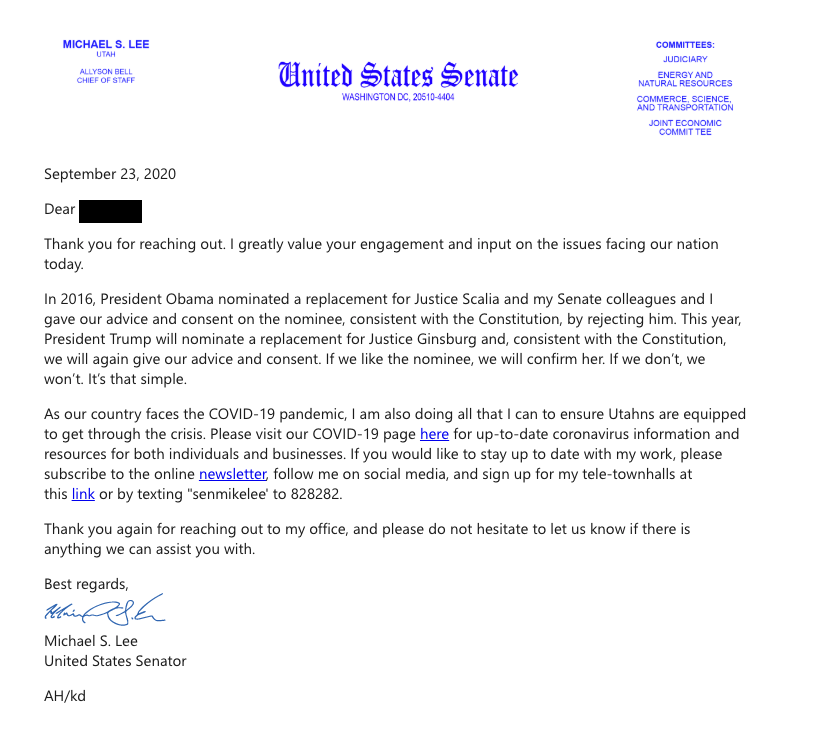
- 2016: After Justice Antonin Scalia died, Senate Republicans refused to give President Obama’s nominee, Merrick Garland, a hearing or a vote, arguing that voters should decide in an election year. Utah Senator Mike Lee signed that pledge. In 2020, he explained the approach more simply in a letter to a constituent: “If we like the nominee, we will confirm her. If we don’t, we won’t. It’s that simple.” That year, the Senate confirmed Amy Coney Barrett eight days before Election Day. Democrats reversed themselves too, demanding a vote in 2016 and arguing for waiting in 2020.
- 2017: Senate Republicans extended the same change to the Supreme Court to confirm Neil Gorsuch.
- 2018: Republicans stopped honoring “blue slips” for appeals court nominees, ending a home-state senator’s ability to block a nominee from their state. In 2026, President Trump has pushed to end blue slips for trial courts too.
- 2024 and 2026: Both parties used lame-duck sessions to rush through as many judges as possible before losing the Senate, Democrats in 2024 and Republicans right now.
Each step made sense to the party taking it. Together, they turned confirmation from a bipartisan check into a party-line formality. When the majority party can confirm anyone it wants with its own votes, there’s no reason for a president to nominate someone the other side could accept, and no reason for the majority to say no to a weak or loyal-only nominee from its own president. Accountability depends on someone across the aisle having a say.
What happens next matters
Democrats take control of the Senate in January. The temptation will be to do to Trump’s nominees what Republicans did to Merrick Garland: block everything. That would be a mistake. It would leave courts understaffed, slow down justice for ordinary people, and push the next majority to retaliate.
The better path is a higher standard, applied the same way no matter who’s president.
What I’d change
- No lifetime seat for anyone who won’t state the facts. Any nominee, from any president, who can’t say plainly that Joe Biden won the 2020 election and that January 6 was an attack on the Capitol should get a no vote. I’d say the same about any nominee who denied the results of an election their own party lost.
- Bring back a bipartisan threshold for lifetime judges. Restore a 60-vote requirement for appeals court and Supreme Court confirmations. To keep it fair, start it with the next president’s term, so neither party can claim it was rigged against them.
- Independent vetting before any hearing. Every nominee should be reviewed by a nonpartisan panel of lawyers and retired judges, whether the ABA or a new body both parties agree on, and the rating should be public before senators vote. A nominee rated “Not Qualified” should need votes from both parties to be confirmed.
- Keep blue slips for trial court judges. Home-state senators know their state’s lawyers and judges best. Utah’s senators should have a real say in who sits on Utah’s federal bench, no matter who the president is.
- No lame-duck lifetime appointments. After an election that changes control of the Senate, the outgoing majority shouldn’t fill lifetime seats. That rule should bind both parties, because both have done it.
- Confirm qualified nominees, even from the other side. The new Democratic Senate should confirm Trump nominees who are qualified and independent, and reject the ones who aren’t. Fair is fair.
Judges aren’t supposed to be on anyone’s team. The Senate is the only thing standing between a president and a bench full of loyalists, and right now it isn’t standing. Utahns of every party should want judges who call balls and strikes, and a Senate with the backbone to make sure that’s who we get.
Sources
- Demand Justice: how Trump’s judicial nominees avoid the truth on 2020 and January 6 (progressive group)
- Houston Public Media: Texas nominees decline under oath to say whether Biden won
- Democracy Docket: nominees’ claim that saying Biden won would be a political statement
- Above the Law: former January 6 prosecutors ask the Senate to stop confirming election deniers
- Nomination Notes: nominees still say Biden was only “certified” (November 2026)
- NBC News: Senate confirms Emil Bove despite whistleblowers
- AOL/USA Today: Collins and Murkowski join Democrats in opposing Bove
- Bloomberg Law: Senate confirms Katie Lane, rated unqualified by the ABA
- HuffPost via Yahoo: why the ABA rated Lane not qualified, and the record of past presidents
- Bloomberg Government: the ABA’s first “not qualified” rating of Trump’s second term
- Wikipedia: Donald Trump judicial appointment controversies, including ABA ratings
- Wikipedia: Kathryn Kimball Mizelle and her ABA rating
- Denver Gazette: Bondi ends the ABA’s role in vetting Trump’s judicial nominees
- ABA Journal: the ABA responds that the data doesn’t support claims of bias
- Law&Crime: the ABA rated all three of Trump’s Supreme Court picks “Well Qualified”
- Bloomberg Government: Republicans plan a lame-duck push before Democrats take over
- Just the News: both parties have run the lame-duck judicial play
- Daily Signal: the race to confirm nominees and the push to end blue slips
- Senator Mike Lee’s letter to a constituent, September 23, 2020 (recipient’s name redacted), quoted in How we lost the check
- Senator Grassley: Judiciary Committee Republicans’ 2016 letter refusing hearings on a Supreme Court nominee
- Salt Lake Tribune: Senators Hatch and Lee join the pledge, and won’t meet with the nominee (2016)
- FactCheck.org: wait times for Obama’s and Bush’s judicial nominees
- Obama White House archive: Robert Bacharach confirmed unanimously after nearly a year of delay
- PBS NewsHour: the 2013 rule change and the history of filibusters of nominees
- Brennan Center: why the Senate went “nuclear” on filibusters
- Washington Times: Republicans block Millett, and Democrats’ earlier filibuster of Miguel Estrada